
Let’s Understand the Methodology Of Rainwater Harvesting To Save Water
Methodology Of Rainwater Harvesting
Methodology of Rainwater harvesting can be divided into two categories:
Surface runoff harvesting and rooftop rainwater collection. Rainwater harvesting is the process of collecting and storing rainwater for on-site reuse rather than letting it run off. The water is used for a variety of reasons, including gardening, irrigation, and so on. This post discusses a variety of rainwater gathering techniques.
1. Methodology of Rainwater Harvesting : Surface Runoff Harvesting
Rainwater runs off the surface of the ground in metropolitan environments. By using appropriate technologies, this discharge can be captured and used to recharge aquifers.
2. Methodology of Rainwater Harvesting : Rainwater Harvesting on the Roof
It is a rainwater collection system that captures rainwater as it falls. The roof becomes the catchment in rooftop harvesting, and rainwater is collected from the house/building’s roof.
It can either be stored in a tank or diverted to a man-made replenishment mechanism. This method is less expensive and extremely effective, and it aids in supplementing the area’s groundwater level if properly done.
Rooftop Rainwater Harvesting System Components
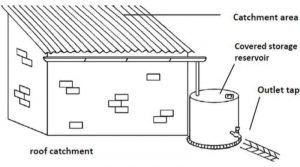
The typical schematic diagram in Fig 1 shows the illustrated design of the major components of the rooftop rainwater collection system. The system is made up of the following sub-components:
1. The catchment area
The catchment of a rainwater collecting system is the surface that collects rainfall directly. It could be a terrace, a courtyard, or open ground, paved or unpaved.
A flat RCC/stone roof or a sloping roof might be used for the terrace. As a result, the catchment is defined as the area that contributes rainwater to the rainwater harvesting system.
2. Transportation
Rainwater from the roof should be brought down to the storage/harvesting system via water pipes or drains. UV-resistant water pipes (ISI HDPE/PVC pipes) with the requisite capacity should be used.
Rainwater from sloping roofs might be collected in gutters and channeled down the pipe. Wire mesh should be installed at the mouth of each drain on terraces to prevent floating material.
3. The Initial Flush
The first flush is a mechanism that removes the water from the first shower. The initial rain shower should be cleaned off to prevent contaminants from the atmosphere and the catchment roof from contaminating storable/rechargeable water.
During dry seasons, it will also aid in the removal of silt and other debris from the roof. At the exit of each drainpipe, initial rain separators should be installed.
4. Use a filter
Rooftop Rainfall Harvesting has always been met with suspicion, since concerns have been expressed that rainwater could contaminate groundwater. If the necessary filtration mechanism is not implemented, there is a remote chance that this dread will come true.
Second, extreme caution must be taken to ensure that underground sewer drains are not ruptured and that no leaking occurs in the immediate neighbourhood.
Filters are used to purify water such that turbidity, colour, and germs are properly removed. Water should pass through filters after the first flushing of rainfall.
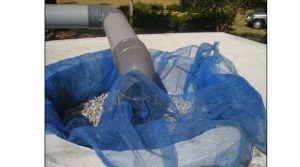
On top of the storage tank, a gravel, sand, and ‘netlon’ mesh filter is constructed and installed. This filter is critical for keeping rainwater clean in the storage tank. Silt, dust, leaves, and other organic debris are kept out of the storage tank by this device.
After each rainstorm occurrence, the filter media should be cleaned on a daily basis. Filters that are clogged make it difficult for rainwater to reach the storage tank, and the filter may overflow. Before replacing the sand or gravel media in the filter, it should be removed and rinsed. Figure 2 depicts a typical filter photograph.
Filters used in methodology of rainwater harvesting
Filters come in a variety of shapes and sizes, but their primary purpose is to purify water. The following section discusses various types of filters:
1. Filter made of sand and gravel
Brick masonry is used to construct these filters, which are filled with pebbles, gravel, and sand. Wire mesh should be used to separate each layer.
2. Activated Charcoal Filter
In-situ or in a drum, charcoal filters can be manufactured. The drum or chamber should be filled with pebbles, gravel, sand, and charcoal, as illustrated in the diagram. Wire mesh should be used to separate each layer. If there is any odor, the thin coating of charcoal is utilized to absorb it.
3. PVC Pipe filter
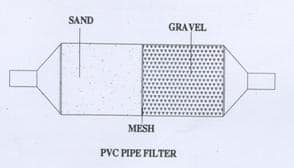
This filter can be manufactured out of PVC tubing with a length of 1 to 1.20 m and a diameter that varies depending on the size of the roof. A 1500-square-foot roof requires six-inch-diameter pipe, whereas roofs larger than 1500-square-foot require eight-inch-diameter pipe. Wire mesh divides the pipe into three parts.
As shown in the diagram, alternate filling each component with gravel and sand. Between two layers, a layer of charcoal could be added.
To connect the inlet and exit, both ends of the filter should be reduced to the desired size. This filter might be installed in the system horizontally or vertically. Figure 3 depicts a schematic pipe filter.
4. Sponge Filter
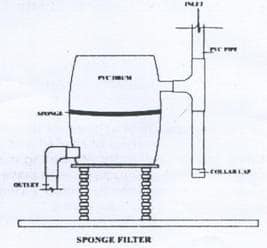
It’s a simple filter built from a PVC drum with a sponge layer in the middle. It is the simplest and cheapest type of filter for household use. Figure below is a standard sponge filter figure.
Rooftop Techniques / Methodology of Rainwater Harvesting
This section shows how to use roof top methodology of rainwater harvesting in a variety of ways.
1. Direct Use Storage
Rainwater collected from the building’s roof is channelled to a storage tank in this way. Water requirements, rainfall, and catchment availability must all be considered while designing the storage tank.
Before connecting to the storage tank, each drainpipe should have a mesh filter at the mouth and a first flush mechanism, followed by a filtration system. An excess water overflow system should be installed in each tank.
Water that isn’t being used could be diverted to the recharge system. Water from storage tanks can be utilized for a variety of applications, including laundry and gardening. This is the most cost-effective method of collecting rainwater.
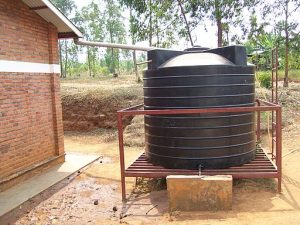
The biggest benefit of collecting and using rainwater during the rainy season is that it not only saves water from traditional sources, but it also saves energy on water transportation and distribution at the doorstep. If groundwater is being extracted to satisfy demand when rains are falling, this helps to conserve it. Figure 5 depicts a common storage tank.
2. Groundwater Aquifer Recharge
Groundwater aquifers can be recharged in a variety of ways to guarantee that rainwater percolates into the ground rather than draining away from the surface. The following are some of the most commonly utilized recharging methods:
Recharge Using Borewells
Recharge Using Dugwells.
Recharge Pits.
Trenches Recharge
Recharge Shafts or Soakaways
Tanks for Percolation
3. Bore Well Recharging
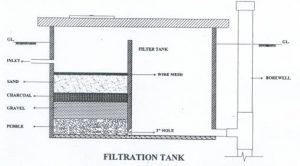
Rainwater collected on the building’s roof is channeled to a settlement or filter tank via drainpipes. Filtered water is transferred to bore wells after settlement to fill deep aquifers. Bore wells that have been abandoned can also be used for recharge.
The settlement tank/filtration tank’s maximum capacity can be calculated using the catchment area, rainfall intensity, and recharging rate. Floating matter and silt should not be let into the recharge structure since they can clog it.
To avoid contamination, the first one or two showers should be cleaned off through the rain separator. A schematic illustration of a filtration tank recharging to the bore well is shown in Figure 6.
4. Recharge Pits
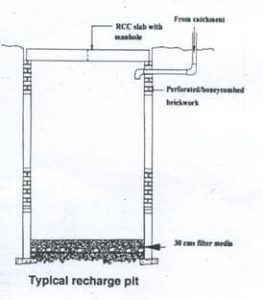
Recharge pits are small pits of any shape, such as rectangular, square, or circular, enclosed by a brick or stone masonry wall and perforated by weep holes at regular intervals. Perforated covers can be used to cover the top of the pit. Filter media should be placed in the pit’s bottom.
The pit’s capacity can be calculated using the catchment area, rainfall intensity, and soil recharging rate. Depending on the depth of prior strata, the pit’s dimensions are usually 1 to 2 m wide and 2 to 3 m deep.
These trenches are ideal for replenishing shallow aquifers and constructing modest homes. Figure 7 is a schematic diagram of the recharging pit.
5. Recharge Shafts or Soakway
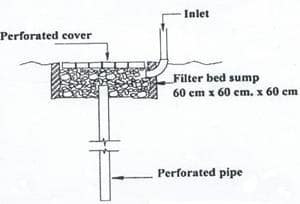
Where the overlying layer of soil is alluvial or less porous, soak away or recharge shafts are provided. These are bore holes with a diameter of 30 cm that can reach a depth of 10 to 15 meters, depending on the depth of the pervious layer. To prevent the vertical sidewalls from collapsing, the bore should be lined with slotted/perforated PVC/MS tubing.
The appropriate size sump is built at the top of the soakaway to absorb runoff before it filters through the soakaway. Filter media should be placed in the sump. Figure 8 is a schematic diagram of the recharging shaft.
6. Replenishment of Dug Wells
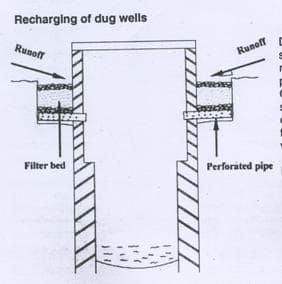
Wells that have been dug can be used as a recharge structure. After passing through the filtration bed, rainwater from the rooftop is channeled to drilled wells. To improve the recharge rate, the dug well should be cleaned and desalted on a regular basis. It is possible to employ the filtration method described for bore well refilling. A schematic diagram of recharging into a dug well is shown in Figure 9.
7. Recharge Trenches
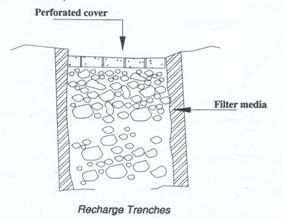
Where the upper impermeable layer of soil is shallow, a recharge trench is provided. The recharge trench is a hole in the earth that is filled with porous media such as pebbles, boulders, or brickbats. It’s typically used to collect surface runoff.
Bore-wells can also be used as recharging shafts inside the trench to improve percolation. The length of the trench is determined by the expected amount of runoff.
Small dwellings, playgrounds, parks, and roadside drains can all benefit from this method. The recharging trench can range in width from 0.50 to 1.0 m and depth from 1.0 to 1.5 m. Figure 10 shows a schematic diagram of trench recharging.
8. Percolation Tank
Percolation tanks are man-made surface water bodies that submerge a land area with enough permeability to allow sufficient percolation to recharge the groundwater. These can be erected on large campuses with accessible land and acceptable topography.
This tank can be used to collect surface runoff and roof top water. Water that collects in the tank percolates into the soil, supplementing the groundwater supply.
The water that has been saved can be utilized immediately for gardening and raw consumption. Percolation tanks should be installed in metropolitan areas’ gardens, open spaces, and roadside greenbelts.